.png)
AI Assistance vs Authorship: Where Should Writers Draw the Line?

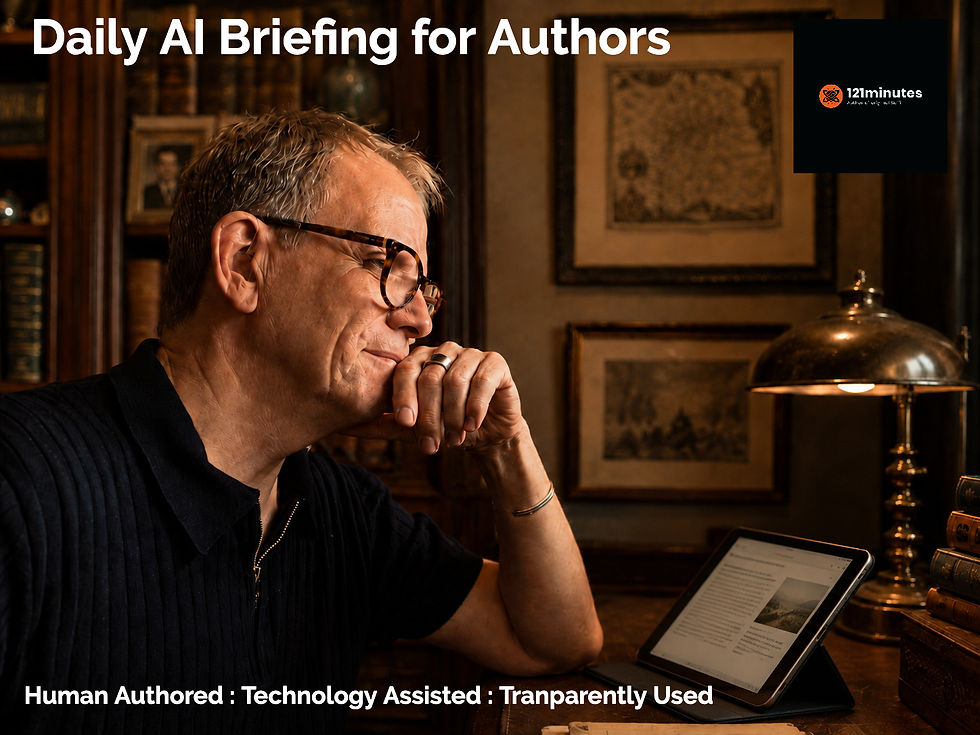
When AI assistance crosses an editorial line
Today’s strongest writing-and-AI story comes from the Financial Times. The newspaper issued a clarification after discovering that artificial intelligence had been used to condense a longer draft of a column before it was submitted for editorial review. The FT says that use breached its editorial code, which prohibits AI in the writing process.
The episode is useful because it exposes a problem writers and publishers are going to face repeatedly: “AI was used” is not a precise description of what happened. There is a meaningful difference between asking a model to create an argument, asking it to rewrite prose, using it to shorten material already written by a human, and using AI outside the manuscript for research organisation, visualisation or marketing.
Why writers should care
Publishing is rapidly becoming a trust business as much as a content business. Recent reporting describes agents and publishers struggling to verify whether manuscripts are genuinely human-authored, while AI-generated and AI-assisted books add volume to already crowded markets. The danger is that crude rules or unreliable detection systems can treat very different creative workflows as though they are identical.
For working authors, the practical response is not to pretend AI does not exist. It is to decide where the creative boundary sits and make that boundary understandable. If the story, characters, prose and creative decisions are yours, say so. If AI is used around the business of authorship rather than to generate the fiction itself, explain that distinction plainly.
Assistance is not the same as authorship
This distinction matters because authorship is ultimately about creative responsibility. A spelling checker can alter a sentence. An editor can suggest that a chapter be cut. A research tool can surface information. None of those things automatically becomes the author of the work. Generative AI complicates the picture because it can also produce finished language, but the useful question remains: who is making the substantive creative decisions?
That suggests a more mature vocabulary for the publishing industry. Instead of a binary label — AI or no AI — we may need to distinguish AI-authored, AI-generated, AI-assisted and human-authored work, with clearer expectations attached to each.
Creative provenance may become valuable
Writers may also benefit from keeping a stronger creative trail: outlines, notes, manuscript versions, tracked changes and dated drafts. This should not become a demand that every writer prove innocence. But when authorship is challenged, a genuine history of how a book developed is far more meaningful than somebody pointing at a sentence and claiming that it “sounds like AI”.
There is an unexpected upside. As synthetic content becomes cheap and abundant, readers may place greater value on knowing that a human being actually imagined, struggled with and completed the story in front of them. Human authorship could become part of a book’s provenance rather than something everyone simply assumes.
The line worth defending
The strongest position for authors is neither blind rejection nor wholesale delegation. AI can be extremely useful around a creative career — research support, visualisation, advertising, metadata, social content and administrative work can all reduce the burden on an independent writer. But using technology to support the author is fundamentally different from asking technology to replace the author.
Today’s question
Where do you draw the line: at AI-generated prose, AI rewriting, AI editing — or somewhere else entirely? And should publishers distinguish between those uses rather than treating every encounter with AI as the same thing?
AI & The Author — daily observations on artificial intelligence, writing, publishing and what all of this means for people who still sit down and make things up for a living.
Want to know more. Subscribe and get these briefings direct to your inbox
Rob Frankson bio
Born in London within the sounds of Bo Bells which makes me a Cockney. Moved to Essex which makes me an Essex boy. Married a beautiful Essex girl and have been dancing with her around a handbag for over thirty years . Moved to Kent and that made me a Kentish man and now we are in Suffolk which apparently makes me a Tractor Boy.
Love my family and friends and I seem to have a never ending creative well of schemes and adventures that keeps everyone amused, befuddled and exasperated.
On the Serious side my IT consultancy skills and knowledge are extensive and have kept me in business for a long time. My writing keeps me sane (mostly) and on occasion I have even been known to play a guitar or two.
But never ever ask me to cook, feed me or get me wet after midnight
Love Sci-Fi? Dive into 121 Minutes for original novels, short stories, and resources.


Comments