.png)
AI Is Making Authors Prove They’re Human: Publishing’s New Provenance ProbleM

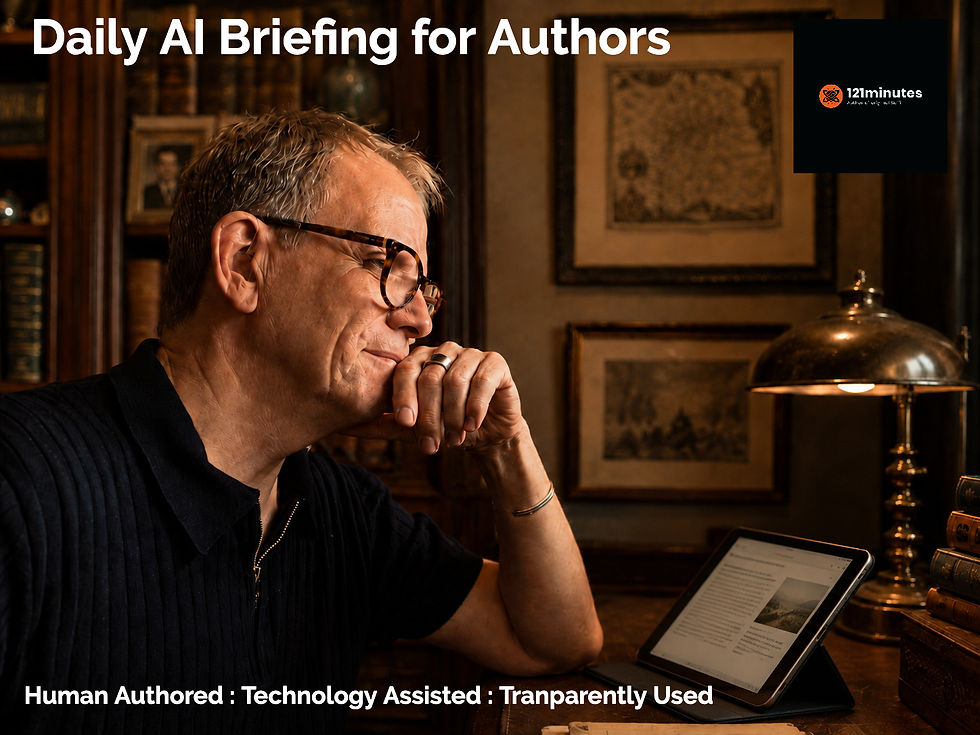
Publishing has spent the past few years asking whether artificial intelligence can write a book. This week, the more urgent question is becoming: how does an author prove that a human did?
A fresh wave of publishing controversy has pushed that question into the centre of the industry. High-profile manuscripts have been withdrawn or scrutinised after suspicions of generative-AI use, while authors, agents and publishers are discovering that AI-detection software is not a reliable substitute for trust. The result is uncomfortable: writers may increasingly be asked not merely to deliver a manuscript, but to demonstrate how they created it.
The provenance problem
The Wall Street Journal reported this week that publishing is struggling with an AI-authorship crisis following several prominent disputes. Jerry Falade’s debut crime novel Call Me, I’ll Hide the Body attracted major publishing interest before deals collapsed amid questions about AI use, which Falade denies. Other books and authors have faced similar scrutiny.
The wider argument is captured in the Wall Street Journal’s reporting, which describes an industry caught between rapidly improving tools and the absence of an agreed way to establish authorship.
That distinction matters. Suspicion is not proof. AI detectors can produce false positives, and treating a probability score as a verdict risks creating a publishing environment in which an author can be forced to defend genuine work against a machine’s guess.
Publishers are moving towards disclosure
The direction of travel is nevertheless becoming clearer. HarperCollins chief executive Brian Murray recently argued that publishing needs industry-wide solutions and suggested authors may eventually need to retain evidence of their writing process. Meanwhile, major academic and professional publishers are formalising disclosure rules.
For example, Oxford University Press requires detailed disclosure of generative-AI use in content generation or preparation. Elsevier’s updated July 2026 policy similarly requires authors to document AI use, its purpose and the extent of human oversight. Wiley distinguishes trivial assistance such as basic grammar checking from substantive AI drafting, rewriting, analysis and image generation that should be declared.
This feels more workable than trying to ban a technology that is already embedded in everyday software. Word processors, search tools, image editors, transcription services and marketing platforms increasingly contain AI features. A simple declaration of “AI used” therefore tells a reader surprisingly little. What matters is what the AI actually did.
Assistance is not authorship
For writers, I think this is the line worth defending. There is a profound difference between asking a machine to produce the novel and using AI around a human-written novel. I write my fiction. The characters, worlds, story decisions and prose are mine. But I am comfortable using AI elsewhere in the creative business: visualising ideas, researching subjects, organising material, exploring marketing concepts and helping turn one piece of work into material suitable for different channels.
Those activities do not need to be hidden. In fact, being explicit about them may become an advantage. The more synthetic material floods the market, the more valuable provenance becomes. A reader who knows what was human-created, what was machine-assisted and who ultimately took responsibility can make an informed choice.
Keep the receipts
There is also a practical lesson for authors: start preserving your creative trail. Keep manuscript versions. Retain notebooks and research notes. Use version history. Keep dated drafts. If you dictate, retain recordings where sensible. None of this should become an oppressive bureaucratic exercise, but a healthy archive of the writing process may become increasingly useful when submitting work, negotiating contracts or answering an unfair allegation.
Ironically, this could restore value to something writers have always done: the messy evidence of creation. Deleted scenes, half-finished chapters, contradictory outlines and terrible first drafts are not failures. They are fingerprints.
A trust mark for books?
The Authors Guild already operates its Human Authored certification in the United States, while the UK Society of Authors launched its own human-authorship initiative earlier this year. These schemes are imperfect, but they point towards an emerging idea: provenance may become part of the product.
The Authors Guild’s Human Authored programme defines qualifying work as text authored by humans rather than generated by AI, while allowing very small uses such as AI-powered spelling or grammar assistance.
I suspect the long-term answer will not be an AI detector sitting at the publisher’s gate. It will be transparent declarations, sensible contractual definitions and a chain of creative provenance that allows authors to say, confidently, “This is what I made, and this is where technology helped me.”
The opportunity hidden inside the crisis
For genuine authors, that is not necessarily bad news. Cheap automated books can compete on volume, but human authors can compete on identity, connection and trust. Readers do not simply buy sequences of grammatically correct sentences. They follow writers because they want another encounter with a particular imagination.
AI therefore presents authors with two very different choices. We can use it to replace the difficult creative work and risk making ourselves interchangeable with the technology. Or we can use it to remove friction around that work research, organisation, visualisation, administration and marketing. Whilst keeping the thing readers actually came for resolutely human.
For me, that second model is far more interesting. The future author may be technologically augmented, but authorship still needs a human being willing to put their name, judgement and responsibility behind the work.
What do you think?
Should publishers require authors to provide a record of how a manuscript was created. Or would that turn legitimate writers into suspects until they prove themselves human?
About the author
Rob Frankson is a science-fiction author and creator of the Near Galaxy Saga. Through 121 Minutes, he writes about storytelling, publishing, technology and the changing creative landscape.
Stay with 121 Minutes
For more from AI & The Author, science fiction, publishing and the Near Galaxy Saga, visit 121 Minutes and follow the continuing conversation.
AI & Editorial Transparency
AI & The Author is edited and published by Rob Frankson. Artificial intelligence is used to assist with news research, initial drafting, content organisation and supporting imagery. All articles are reviewed and, where necessary, edited by Rob Frankson before publication. The opinions, editorial position and final decision to publish remain the author's.
Keep up with AI & The Author
Want these briefings direct to your inbox? Join the 121 Minutes Universe for updates, articles and writing resources.
Rob Frankson bio
Born in London within the sounds of Bow Bells, Rob Frankson is an author, IT consultant and lifelong science-fiction enthusiast. His writing keeps him sane (mostly), while a never-ending creative well of schemes and adventures keeps everyone around him amused, befuddled and occasionally exasperated.
Explore more original science fiction, novels, short stories and author resources at 121 Minutes.


Comments