.png)
AI Books Are Flooding the Market. Are there any Human Authors Still Out there ?

There is a new problem forming in publishing, and it is not really about whether artificial intelligence can write a readable book. It is about what happens when machines make it possible to manufacture books faster than readers can possibly discover them.
For working authors, that distinction matters. We have spent years debating AI as a creative question: can it write, should it write, and what counts as authorship? But the commercial question may prove just as important. If online bookshops are flooded with machine-generated titles at industrial speed, a genuinely human-written novel does not have to lose a literary argument to lose a sale. It can simply disappear beneath the volume.
That concern moved sharply into focus this week after Fortune reported on 14 September on research examining the growth of AI-generated books in online marketplaces. The study, which has not yet been peer-reviewed, analysed thousands of self-published genre-fiction titles and found substantial levels of AI-generated prose among the books tested. More importantly for authors, the researchers reported evidence of a crowding effect: the number of books showing sales grew much faster than the revenue generated by the market as a whole.
The problem is abundance, not just quality
It is tempting to dismiss this as a quality problem. Bad books have always existed. Vanity publishing existed long before generative AI, and digital self-publishing already made it possible to release work with very little gatekeeping. Readers are not suddenly incapable of recognising a good story.
But generative AI changes the economics of volume. A human novelist might spend a year or several years creating one book. A producer using generative systems can create, package and test many titles in a fraction of that time. Even if most of those books are mediocre, they still occupy search results, recommendation slots, keywords and category pages. Discovery systems do not have infinite space.
That is where this becomes a problem for independent and mid-list authors. The danger is not necessarily that a reader compares a carefully written novel with an AI-generated one and deliberately chooses the machine. The danger is that the human book never reaches the reader's screen.
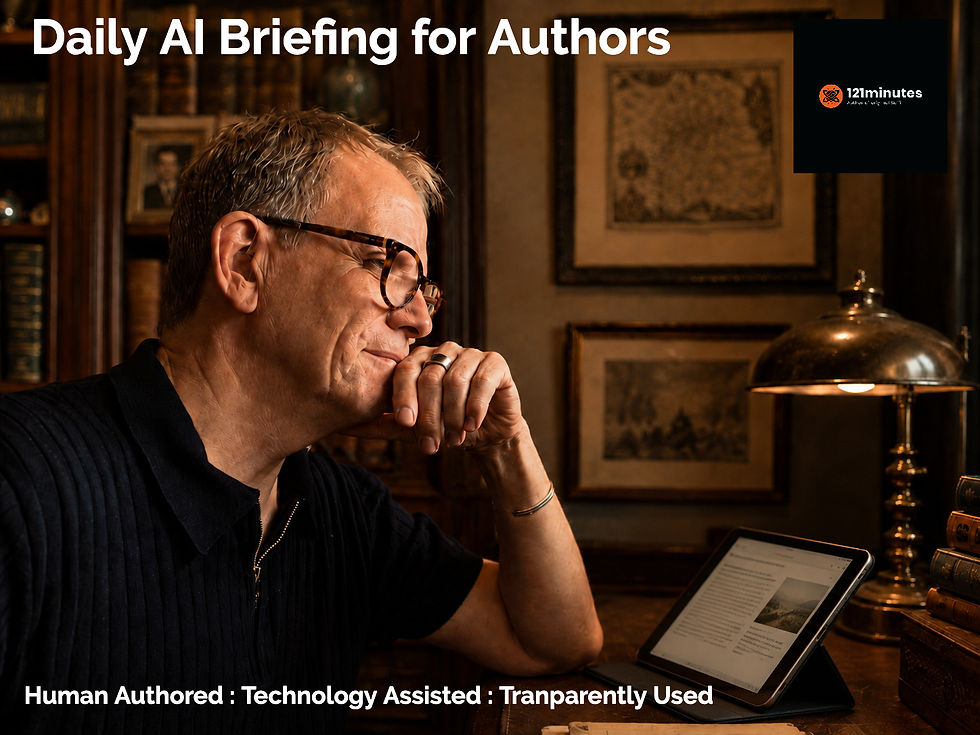
Amazon already draws a line between generated and assisted
The distinction is especially interesting because Amazon KDP's current content guidelines already separate AI-generated content from AI-assisted work. KDP requires publishers to disclose AI-generated text, images or translations, while it does not require disclosure when AI is used to edit, refine, error-check or brainstorm material that the author ultimately creates.
That is a sensible distinction, and it closely matches how I think about AI in my own work. I write my books. The characters, worlds, choices, scenes and final prose are mine. I am perfectly comfortable using AI around that creative work for research, visualisation, organisation, marketing and the practical business of being an author. Those activities do not make the machine the author of the novel.
Generating the novel itself is different. And generating dozens or hundreds of books simply to occupy commercial shelf space is different again.
Disclosure alone may not solve discovery
This is where publishing may need to move beyond the disclosure debate. Knowing that a book contains AI-generated material is useful, but disclosure does not automatically protect discovery. If thousands of generated titles can still enter the same recommendation and search systems as human-created work, the economic pressure remains.
There are difficult questions here. Should online booksellers visibly label AI-generated books for readers? Should search tools allow readers to filter them? Should recommendation algorithms treat industrial-scale generated publishing differently from ordinary author publishing? And how do platforms do any of that without falsely accusing writers who legitimately use AI-assisted editing or marketing tools?
Those questions are uncomfortable because crude AI detection is not a reliable foundation for judging authors. A false accusation can damage a writer's reputation. The answer cannot simply be to run every manuscript through a detector and declare a percentage to be truth.
That is also why today's argument connects with Jane Friedman's 16 September observation that writing organisations should engage with AI questions rather than avoid them. Writers now need practical conversations about contracts, disclosure, detection, copyright and publishing policy. Silence does not make those questions disappear.
Human authors need a stronger signal
My concern is not that AI will suddenly learn how to care about a character more deeply than a writer does. The more immediate threat is much duller and therefore easier to underestimate: scale. A marketplace designed for thousands of new books can behave very differently when machines can produce millions.
That makes human authorship something worth signalling positively rather than merely treating AI as something that must be disclosed negatively. Readers who want human-written fiction should be able to find it. Authors who spend years developing their craft should not have to compete invisibly against industrial content generation without the marketplace even acknowledging that the two products were created in fundamentally different ways.
None of this requires writers to become anti-technology. Quite the opposite. AI can be an extraordinarily useful tool around the creative process. But useful tools should strengthen authorship, not make authors impossible to find.
The question for writers
If AI-generated books continue to grow rapidly, should online bookstores give readers a clear way to identify and filter for human-written books — or should every book compete in exactly the same marketplace regardless of how it was created?
Quick Shortcuts
Rob Frankson is a science-fiction author and creator of the Near Galaxy Saga. Through 121 Minutes he writes about storytelling, publishing, creativity and the changing relationship between authors and artificial intelligence.
AI & Editorial Transparency
AI & The Author is edited and published by Rob Frankson. Artificial intelligence is used to assist with news research, initial drafting, content organisation and supporting imagery. All articles are reviewed and, where necessary, edited by Rob Frankson before publication. The opinions, editorial position and final decision to publish remain the author's.


Comments