.png)
AI Detectors Are Becoming Publishing Gatekeepers — But Can Writers Trust Them?
- Rob Frankson
- 13 hours ago
- 4 min read

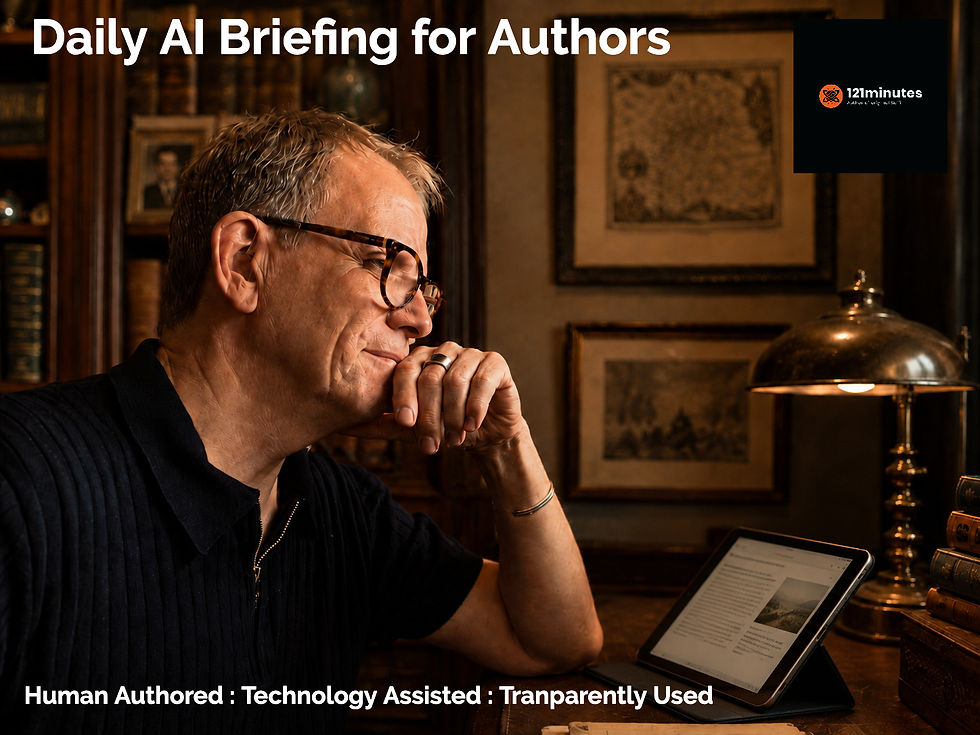
AI & The Author — 4 September 2026
Artificial intelligence, writing, publishing and what the latest developments mean for working authors.
Quick Shortcuts
The AI detector now influencing publishing decisions • Why human-authorship certification remains difficult • About Rob Frankson
AI detection is becoming a publishing gatekeeper
A new kind of gatekeeper is moving into publishing. It is not an editor, agent or bookseller. It is software trying to decide whether a human wrote the words.
Wired reported on 3 September that Pangram, an AI-text detection company, is increasingly being used by publishers, educators and online platforms to estimate how much of a piece of writing may have been generated by artificial intelligence. The company has attracted attention after its analysis of the novel Shy Girl contributed to questions over the book’s authorship and the cancellation of its publication. Pangram says its system has a very low false-positive rate; critics remain concerned about accuracy, bias and what happens when an automated judgement carries real professional consequences.
For authors, that is the important part of the story. AI detection is no longer merely an academic exercise. A score produced by software can potentially affect whether a manuscript is trusted, investigated, acquired or rejected.
Detection is not the same as proof
There is an understandable reason publishers want these tools. Generative AI can now produce large volumes of plausible prose quickly, and publishers need some way of dealing with undisclosed machine-generated submissions. Nobody benefits if a market built on writers and readers becomes flooded with synthetic books presented as conventional human work.
But detection introduces another problem: probability can begin to look like proof.
A detector does not sit beside a novelist for six months and watch the book develop. It does not see the notebooks, deleted chapters, version history, research, bad first drafts and late-night rewrites. It analyses the finished language and makes an inference from patterns in that language.
That can be useful evidence. It is not the same thing as establishing authorship.
This matters particularly because writers do not all write in the same way. Genre conventions, concise prose, second-language English, accessibility tools, heavy editing and simply having a highly regular style can all complicate attempts to classify text by statistical characteristics. Publishing needs to be extremely careful before turning an AI probability score into a verdict about a writer’s integrity.
The industry still lacks a clean definition of “AI use”
There is another difficulty. Asking whether a writer “used AI” is becoming far too crude a question.
There is a substantial difference between prompting a system to generate a chapter and writing the chapter yourself while using AI elsewhere in your working life. A novelist might use AI to organise research, explore a visual reference for an invented world, produce marketing concepts, prepare social-media material, analyse website performance or handle routine creative-business administration.
None of those activities makes the machine the author of the novel.
For my own work, that distinction is central. I write my fiction. I am comfortable using AI around the business and visualisation of that fiction, and I am transparent about doing so. Creative responsibility for the stories remains mine.
The publishing industry needs language capable of recognising those differences: human-authored, AI-assisted, AI-rewritten and substantially AI-generated are not interchangeable categories.
Human-authored labels do not completely solve it
The Authors Guild has already tried to address reader uncertainty through its Human Authored certification. But even that exposes the difficulty. The Guild has acknowledged that current AI-detection tools are not sufficiently reliable for it to base certification on automated manuscript analysis, so certification relies substantially on author declaration.
That creates an odd situation. On one side, publishers may increasingly use detectors to flag suspicious manuscripts. On the other, organisations defending human authorship recognise that detectors are not yet reliable enough to certify it.
That tension should tell us something important: technology can assist editorial judgement, but it should not replace it.
Creative provenance may be more valuable than detection
There may be a better long-term answer for serious writers: provenance.
Keep the evidence of making the book. Preserve outlines, research notes, manuscript versions, tracked changes, character sketches and the ordinary mess of creation. Not because writers should have to prove their innocence every time they submit a manuscript, but because the history of a genuine creative work contains information that a detector examining only the final prose can never see.
This week’s wider copyright arguments reinforce the same principle. Authors are being asked to be increasingly transparent about how AI touches their work, while writers and publishers are simultaneously demanding greater transparency about how their books enter AI training systems. Provenance should work both ways.
If publishing is moving towards a world in which origin matters, then we need mechanisms that establish origin fairly rather than systems that merely guess at it.
What writers should do now
I would not recommend rewriting your natural voice simply because you are frightened that an algorithm might dislike it. That would be a perverse outcome: human writers changing human prose to satisfy machines designed to identify machines.
Instead, preserve your creative trail, understand the AI policies of publishers or competitions you submit to, and disclose substantial generative use when it genuinely affects the written work. At the same time, authors should resist the idea that any detector score can automatically establish misconduct.
The goal should not be to make AI invisible. It should be to make creative responsibility visible.
Today’s question
If an AI detector flags a novel as machine-generated, what evidence should a publisher require before questioning the author’s integrity. And should a detector ever be allowed to make that decision on its own?
About Rob Frankson
Rob Frankson is a science-fiction author and creator of the Near Galaxy Saga. Through 121 Minutes he writes about storytelling, publishing, creativity and the changing relationship between authors and artificial intelligence.
AI & Editorial Transparency
AI & The Author is edited and published by Rob Frankson. Artificial intelligence is used to assist with news research, initial drafting, content organisation and supporting imagery. All articles are reviewed and, where necessary, edited by Rob Frankson before publication. The opinions, editorial position and final decision to publish remain the author's.

Comments