.png)
AI Watermarks Could Mislabel Human Writers: Why Publishing Needs Better Proof
- Rob Frankson
- 5 hours ago
- 4 min read

AI & The Author — 1 September 2026
Artificial intelligence, writing, publishing and what the latest developments mean for working authors.
The AI watermark problem is becoming an authorship problem
A new argument over invisible AI watermarks goes directly to one of publishing’s most uncomfortable questions: when does evidence that AI touched a piece of text become evidence that AI authored it?
On 31 August, US law firm ArentFox Schiff warned that AI-assisted drafting, editing and proofreading can leave statistical fingerprints in the wording itself. Today, an analysis published by 360info pushes the concern further, arguing that watermarking systems designed to protect authenticity can also erase the role of the human who prompted, directed, revised and approved a piece of work.
For authors, this matters because publishing is already struggling with trust. Deals have been disrupted by suspicions about AI use, while publishers and writers are simultaneously fighting model developers over the unauthorised acquisition of copyrighted work. A detection system that treats every form of AI involvement as equivalent risks making that trust problem worse, not better.
Quick Shortcuts
A watermark can show contact with AI. It cannot prove authorship.
The appeal of watermarking is obvious. Publishers, educators and readers want some way to distinguish machine-generated material from human work. Statistical watermarking attempts to embed patterns in generated language that can later be detected without inserting an obvious label into the text.
But writing is not a binary process. A novelist might write an entire chapter and ask an AI system to suggest a shorter version of one paragraph. Another writer might use AI to organise research notes, test advertising copy or visualise a location. A third might ask a model to generate the chapter itself. Calling all three “AI-generated” collapses fundamentally different creative acts into one category.
That is particularly dangerous if detection becomes a proxy for guilt. A watermark may indicate that text passed through a particular technological process. It does not tell an editor who invented the characters, built the world, decided what the scene meant, rejected bad suggestions, rewrote the prose and ultimately took responsibility for the finished book.
The distinction authors need publishing to preserve
My own line remains straightforward: AI-authored fiction and an author using AI around the creative business are not the same thing. I do not believe asking a machine to generate a novel and putting a human name on it is equivalent to a writer using technology for visualisation, marketing, research organisation, metadata or administrative support.
The meaningful test is creative responsibility. Who imagined the work? Who made the substantive choices? Who wrote and shaped the manuscript? Who is prepared to stand behind it? Those questions tell us much more about authorship than a detector reporting that a statistical pattern exists somewhere in the prose.
This does not mean authors should ignore provenance. Quite the opposite. Keep notes, outlines, manuscript versions and tracked changes. Not because writers should have to prove their innocence, but because a genuine creative trail is increasingly valuable in a world where both machine-generated text and unreliable accusations about machine-generated text are becoming commonplace.
Copyright is making the same distinction from the other direction
The timing is significant. Sony Music Publishing and Warner Chappell have just sued Anthropic, alleging that copyrighted lyrics and sheet music were unlawfully acquired for training Claude. Anthropic disputes the allegations and says it will defend its practices. The case is about music, but writers will recognise the underlying issue immediately: provenance matters on the input side as well as the output side.
Creators are being asked to tolerate increasingly sophisticated systems built using enormous quantities of human work while also facing pressure to prove that their own work is sufficiently human. That imbalance will become harder to defend.
A sensible publishing framework therefore needs two kinds of transparency. AI companies should be clearer about where training material comes from and what licences govern it. Authors should be able to describe material AI involvement accurately without every use of modern software being treated as machine authorship.
What writers should do now
Do not build your creative process around beating AI detectors. That is the wrong incentive and the technology is too uncertain. Instead, build a process you can explain. Preserve drafts. Keep your own voice at the centre of the manuscript. Decide deliberately which tasks you are comfortable delegating to software and which belong to you as the author.
Most importantly, resist the lazy vocabulary of “AI” versus “no AI”. Publishing needs terms that distinguish human-authored work, AI-assisted work, AI-rewritten work and substantially AI-generated work. Without those distinctions, watermarking risks giving us the appearance of certainty while telling us surprisingly little about who actually created the story.
Today’s question
If an invisible watermark shows that AI touched a piece of writing, what should a publisher actually be entitled to conclude from that. And what evidence should be required before somebody’s authorship is questioned?
About Rob Frankson
Rob Frankson is a science-fiction author and creator of the Near Galaxy Saga. Through 121 Minutes he writes about storytelling, publishing, creativity and the changing relationship between authors and artificial intelligence.
AI & Editorial Transparency
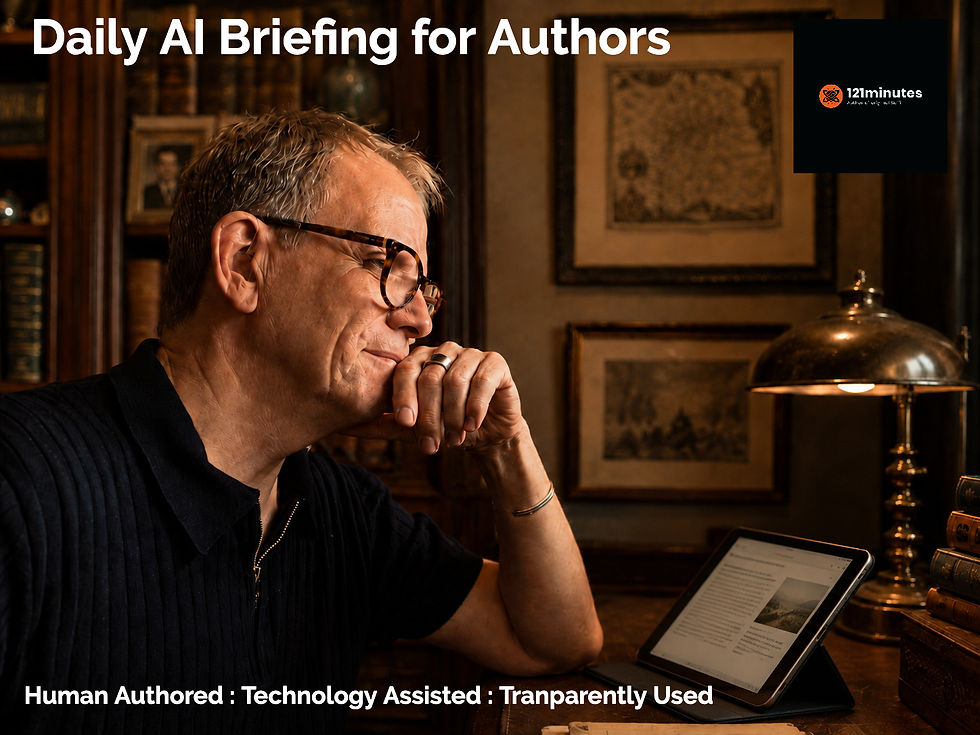
AI & The Author is edited and published by Rob Frankson. Artificial intelligence is used to assist with news research, initial drafting, content organisation and supporting imagery. All articles are reviewed and, where necessary, edited by Rob Frankson before publication. The opinions, editorial position and final decision to publish remain the author's.

Comments