.png)
AI, Authorship and Trust: What Changed for Writers This Week
- Rob Frankson
- Aug 23
- 4 min read

This week, publishing’s AI debate stopped being a distant argument about what machines might eventually do and became a much more immediate question: how do we know who actually wrote a book, what AI involvement should be disclosed, and who remains responsible for the finished work?
Quick Shortcuts
The week publishing’s AI problem became a trust problem
The most important development was not a new writing model. It was the growing realisation that publishing does not yet have a dependable way to distinguish AI-authored work from human writing that has legitimately used AI somewhere around the creative process.
High-profile deals have already collapsed after questions were raised about how manuscripts evolved. That matters even where an author disputes the allegation, because the deeper problem remains: detection software is not the same thing as proof. A manuscript can be excellent and still become commercially toxic if an agent or publisher cannot establish its provenance.
For working writers, that changes the conversation. Drafts, notes, tracked changes and version histories may increasingly have value beyond the writing process itself. They form a creative trail.
Disclosure is moving from principle to policy
At the same time, major parts of publishing are becoming more precise about acceptable AI assistance. Elsevier updated its journal policies on 18 August, explicitly recognising that AI can support tasks such as summarising literature, organising content, generating ideas, explanatory imagery and improving readability, while keeping responsibility with the human author. Nature Computational Science made the same underlying point on 20 August: transparency, accountability and human oversight remain essential.
That distinction is important. “AI was involved” is too crude a label to tell readers anything useful. There is an enormous difference between asking a machine to generate a novel and an author using technology for research support, visualisation, marketing, metadata, organisation or the administrative burden surrounding a creative career.
My own position remains straightforward: the author should be responsible for the creative work. Technology can support that author without becoming the author.
The marketing world is drawing the same line
This week the Interactive Advertising Bureau also released Version 2 of its AI Transparency & Disclosure Framework. Its approach is useful for writers because it is based on materiality rather than the idea that every encounter with AI deserves the same warning label. The framework distinguishes AI-generated and AI-assisted text, imagery, video, audio and other consumer-facing material, while warning against disclosure fatigue.
That matters to independent authors in particular. A novelist today may also be their own publisher, advertiser, designer, social-media team and website manager. AI can assist with some of those surrounding jobs without having written a sentence of the novel being sold.
The other fight is over the books AI learned from
A separate argument intensified on 21 August when civil-society groups urged the US Federal Trade Commission to investigate claims that AI companies acquired, scanned and in some cases destroyed physical books for model training. The complaint reframes part of the training-data dispute as a competition issue as well as a copyright one.
For authors, this remains the uncomfortable other half of the AI debate. We can discuss responsible use by writers while still demanding responsible behaviour from the companies building the systems. Those positions are not contradictory.
What changed this week?
The industry is beginning to move beyond the binary question of whether AI is good or bad for writers. Three more useful concepts are emerging: provenance, disclosure and responsibility.
Provenance asks where the work came from. Disclosure asks whether AI involvement was significant enough to matter to the reader, publisher or customer. Responsibility asks which human being stands behind the final result.
Those ideas offer a much more workable future than unreliable detectors and blanket suspicion. They also protect a distinction worth preserving: AI-authored fiction is not the same thing as human-authored fiction whose creator uses AI elsewhere in the creative business.
What authors should watch next
Watch for publishers and agents to move from vague anti-AI statements towards specific contractual definitions. Watch for creative provenance to become part of submission practice. Watch for platforms to distinguish AI-generated content from AI-assisted workflows. And watch how readers respond once “human-authored” becomes something that can no longer simply be assumed.
There may even be an opportunity here. In a market increasingly flooded with synthetic material, demonstrably human creative work could become more valuable rather than less.
This week’s question
If a writer creates every character, world, scene and sentence of a novel but uses AI for research, visualisation, marketing and running the business around the book, what, if anything should they be required to disclose to readers?
Sources
About Rob Frankson
Rob Frankson is a science-fiction author and creator of the Near Galaxy Saga. Through 121 Minutes, he writes about storytelling, publishing, technology and the changing creative landscape.
Keep up with AI & The Author
Want these briefings direct to your inbox? Join the 121 Minutes Universe for updates, articles and writing resources.
AI & Editorial Transparency
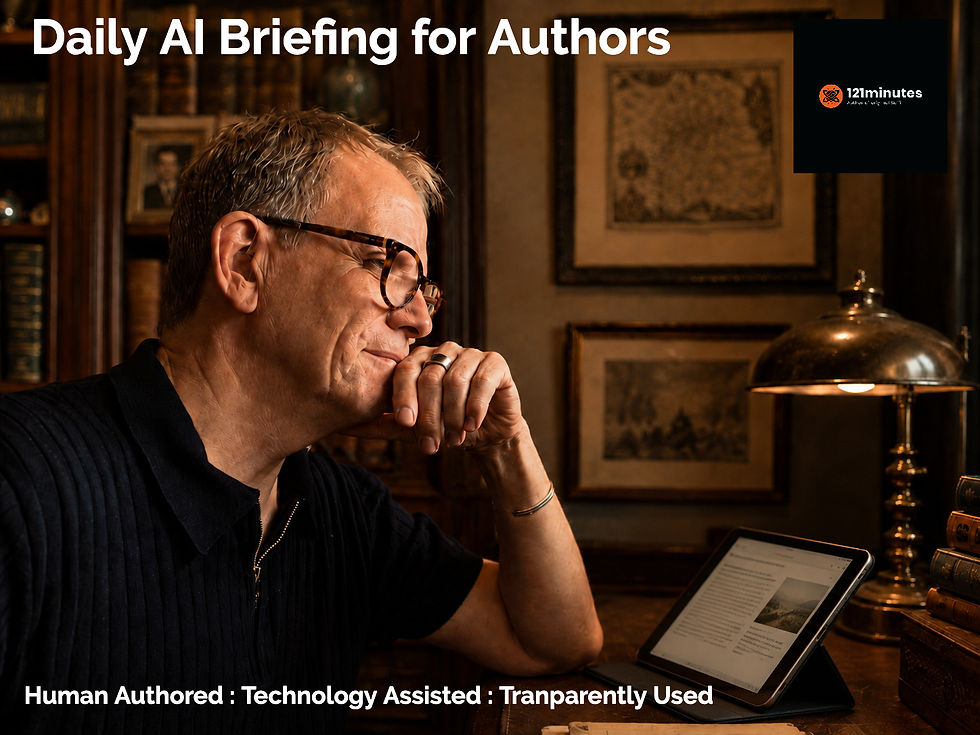
AI & The Author is edited and published by Rob Frankson. Artificial intelligence is used to assist with news research, initial drafting, content organisation and supporting imagery. All articles are reviewed and, where necessary, edited by Rob Frankson before publication. The opinions, editorial position and final decision to publish remain the author's.

Comments