.png)
AI Disclosure Is Becoming the New Publishing Standard — What Authors Need to Know
- Rob Frankson
- Aug 21
- 4 min read

Quick Shortcuts
A strange thing is happening in publishing. The industry has spent years worrying about artificial intelligence replacing writers. Now a more immediate problem is emerging: publishers are struggling to work out whether the writer in front of them actually wrote the book.
This week, the Wall Street Journal reported on growing turmoil around suspected AI use in books, including high-profile publishing deals that have collapsed amid questions about authorship. The difficulty is not simply that generative AI can produce prose. It is that publishers, agents and authors still do not have a universally accepted way of distinguishing legitimate AI assistance from AI authorship.
Publishing has moved from an AI debate to a trust problem
That distinction matters. A writer using AI to brainstorm marketing copy, organise research, visualise a fictional world or help manage the business surrounding a book is doing something very different from generating a novel and presenting the resulting prose as entirely their own work.
Yet the industry is increasingly being forced to make decisions in precisely this grey area. AI detectors are not definitive proof. Writing style is not proof. Suspicion is certainly not proof. But publishers also cannot simply ignore the possibility that manuscripts presented as human-authored may contain substantial machine-generated material.
HarperCollins chief executive Brian Murray recently said publishers, agents and authors need agreed best practices around AI authorship. That may prove more important than another generation of detection software, because publishing has always depended heavily on trust: trust between writer and agent, agent and publisher, publisher and reader.
Disclosure is becoming normal publishing infrastructure
The direction of travel is becoming clearer. Major publishers are increasingly asking authors to explain how AI was used rather than pretending the technology does not exist.
Elsevier’s current book policy requires authors to disclose generative-AI use in manuscript preparation, document the tool, its purpose and the extent of human oversight. It also states that AI cannot be credited as an author because authorship carries responsibility that a machine cannot accept. Wiley similarly tells authors to maintain documentation of significant AI use and to disclose uses that materially affect the work. Oxford University Press has introduced AI-use declarations built around responsible and transparent use.
That is a healthier direction than attempting to divide writers into two crude camps: “AI users” and “non-AI users”. Modern creative work already contains layers of automation. Word processors, spelling systems, recommendation engines, image tools, search systems and editing software increasingly incorporate machine-learning features. The useful question is not whether technology touched the process. The useful question is what creative responsibility remained with the human being.
The author should remain the author
For me, the boundary is fairly straightforward. I write my books. The characters, worlds, plots, dialogue and final prose are mine. AI can be useful around that creative work. I use it for areas such as visualisation, advertising, online content, research support and the practical business of being an independent author.
Those uses do not make an AI the author of the Near Galaxy Saga any more than using Microsoft Word makes Microsoft the author. But if a system generates substantial passages of a novel and those passages are presented unchanged as the writer’s own creative work, we have crossed into a different territory.
That does not mean AI-generated fiction should be banned. There may well be a market for it. The issue is transparency. Readers should be able to understand what they are buying, and publishers should be able to understand what they are acquiring.
What authors should do now
The most practical response for writers is surprisingly old-fashioned: keep your working material.
Save outlines. Keep early drafts. Preserve tracked changes and version histories. Keep research notes. If you use AI materially during a project, make a simple record of what you used it for. Not because writers should have to prove their innocence every time they submit a manuscript, but because a genuine creative trail is far more persuasive than an unreliable detector score.
There is another reason to do this. As AI-generated content becomes abundant, human creative provenance may acquire value of its own. A manuscript with a visible history, abandoned ideas, rewrites, structural changes, notes and drafts tells the story of how a book came into existence. That history could eventually become part of what readers value about human-authored work.
The publishing industry therefore has an opportunity. Instead of building a culture of suspicion around AI, it can build sensible standards around disclosure, provenance and responsibility. Authors should know what needs declaring. Publishers should state clearly what uses are acceptable. Readers should be told when AI has played a substantive creative role.
The alternative is an industry where writers are accused by algorithms, publishers make decisions based on uncertain detection tools, and every unusually polished sentence becomes evidence for the prosecution. That would be bad for writers and ultimately bad for books.
Today’s question
If publishers increasingly ask authors to disclose or document their use of AI, where should the line be drawn between reasonable transparency and forcing writers to prove that they are human?
About Rob Frankson
Rob Frankson is a science-fiction author and creator of the Near Galaxy Saga. Through 121 Minutes he writes about storytelling, publishing, creativity and the changing relationship between authors and artificial intelligence.
Keep up with AI & The Author
Want these briefings direct to your inbox? Join the 121 Minutes Universe for updates, articles and writing resources.
Explore more original science fiction, novels, short stories and author resources at 121 Minutes.
AI & Editorial Transparency
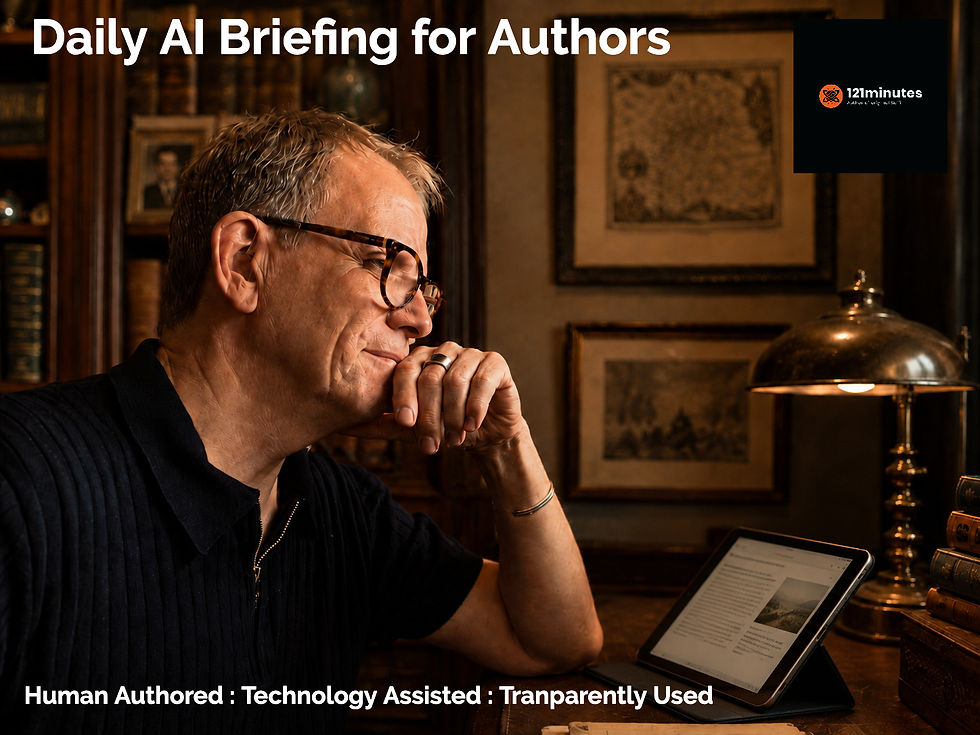
AI & The Author is edited and published by Rob Frankson. Artificial intelligence is used to assist with news research, initial drafting, content organisation and supporting imagery. All articles are reviewed and, where necessary, edited by Rob Frankson before publication. The opinions, editorial position and final decision to publish remain the author's.

Comments